Every public record cited in this account, gathered and grouped by the section that cites it. All of it is drawn from Andover's own minutes, packets and meeting recordings.
The posted agenda for the regular meeting of the Board of Selectmen on Monday, July 13, 2026. The most prominent items were the appointments of new selectmen to replace Carol Lee and Jeff Murray. But also on the agenda: "Discussion and Action on AES Operating Budget Funding Procedure."
A request for records under the Connecticut Freedom of Information Act, submitted to the Town of Andover on July 13, 2026, seeking all documents and communications "concerning any proposed, contemplated, or implemented change to the method, schedule, or amount by which the Town funds the Andover Elementary School operating budget or the Andover Public School Operating Account." The Town's records response of July 16, 2026 is at https://andoverct.info/reference/docs/records-production-2026-07-16.pdf.
The recording of the Board of Selectmen's July 13, 2026 meeting. At about 7:03 the First Selectman moves to delete the item "Discussion and Action on AES Operating Budget Funding Procedure" from the agenda, and the meeting proceeds without it.
The official results, as posted by the town, of the June 16, 2026 referendum. The elementary school's budget, reduced to a 6.0% increase, passed, 420 YES to 317 NO. The RHAM operating budget passed, 479 to 252, and passed region-wide. This is the vote that settled the budget the school operates under in FY 2026-2027.
The recording of the July 23, 2025 Board of Finance meeting, at which the board took up the elementary school's levy schedule (agenda item four, ~2:35) and adopted it unanimously (~16:36). The finance officer explained the board's practice: the district does not submit a broken-out schedule the way the regional district does, so the board divides the appropriation into equal monthly payments. Asked "Has it always been 10?", the answer on the record was that this is "only the third year we did this, because before that we just paid their expenses directly. We had a combined checking account" (~3:40). Video: https://www.youtube.com/watch?v=6KKKZq0tsr4
The minutes of the July 23, 2025 Board of Finance meeting, carried in the following month's packet, record the item as "Levy Schedule for AES Payments -- proposed schedule provided in packet, 10 equal payments from July to April." The motion to accept the schedule as presented was made by board chair Robert England, seconded, and carried 7-0-0. It is the vote behind the schedule and figures in the July 23 packet.
The July 1, 2026, 11:02 AM email from First Selectman Jeff Maguire to Board of Education chair Caitlin Greenhouse, copied to Board of Finance chair Robert England and blind-copied to the Town Treasurer and the Town Administrator, announcing that effective July 1, 2026 the Town would be implementing a revised funding process for the AES operating budget. States its purposes as strengthening cash management, maximizing the investment of Town funds, and eliminating reconciliation issues identified during the Town's annual audit. States that the Town "has deposited" $100,000 into the Andover Public School Operating Account (M&T Bank, account number redacted), effective July 2, 2026, to initiate the new process, and sets out the replacement mechanism: the AES business manager submits weekly check registers and payroll registers, reviewed and approved, to the Town Treasurer, Assistant Treasurer and Town Administrator; the Town then transfers funds equal to the approved disbursements; the business manager prepares a monthly reconciliation; and the Treasurer ensures cumulative funding does not exceed the approved operating budget. Produced in the Town's July 16, 2026 records response, production pages 12-13.
The correspondence, from the Town's July 16, 2026 records response, that establishes in writing that no board voted on the funding change. June 22: the First Selectman sends both board chairs a written "Proposed AES Operating Account Structure" -- the same account, the same weekly registers (pp. 6-7). June 23: BOE chair Caitlin Greenhouse declines in writing; the board is "likely not interested in pursuing this proposal at this time," and she will share it with the full board (pp. 8-9). June 24: he forwards the proposal to all six Board of Finance members "so that we can have a discussion" (pp. 10-11); no meeting of any board takes it up. July 1, hours after the announcement: the chair replies that no responsibility of a First Selectman allows this "without BOF, BOS and BOE approval," that AES should have received one tenth of its operating budget that day, and that the board has reached out to its attorney (pp. 14-15). July 2: BOF chair Robert England: "It is very unclear to me that this is right and proper. First, did the BOS vote on this? The BOF certainly didn't," quoting and attaching the July 23, 2025 minutes of the 7-0 levy-schedule vote (pp. 27-30). July 3: Selectman Anne Creme: she does "not agree," a change "would require a discussion and vote by the Board of Finance and the Board of Education," "The BOS has not discussed or voted on this new process," and "I think you overstepped your role" (p. 31). July 6: the First Selectman himself, in writing: "The Board of Selectmen has not yet voted on this procedural change... Until such time, I am responsible for implementing this change" (p. 38) -- while, the same morning, the change has become "the proposed funding procedure," which the full Board of Selectmen "will have the opportunity to discuss, modify, or affirm" at its July 13 meeting (pp. 32-37).
Asked from the floor about the mask mandate at the elementary school, First Selectman Jeff Maguire, presiding, answered: "This board doesn't have anything to do with the school mandate or how it's addressed. That's the Board of Education. Just so before everybody goes down that road, this board has control of public buildings such as the town hall, the library, the museum, and those types of facilities" (~2:19:39). The question he was answering concerned a school health policy, and his answer concerns which board governs the school. No minutes for this meeting are posted; the speaker is identified from the recording. Video: https://www.youtube.com/watch?v=8Y8S8zglWek
First Selectman Jeff Maguire and Selectwoman Paula King came to the June 14, 2023 Board of Education meeting for a conversation about the community center; the minutes record the chair welcoming them by name. He answered the board's written safety questions, then took up the memorandum of understanding the board's attorney had drafted. On the record he set out the town's position: "The town of Andover is the school district... The town owns all the land. The town owns all the buildings. The town is the owner of everything. There are no deeded properties to a school or to a board of education" (~38:30). Of the memorandum he said "it's not necessary that we really do that," while agreeing to review it, and said the town would go to planning and zoning and move forward (~39:38). Asked whether the school should budget to pave its own upper parking lot, he answered: "It should go to CIP... It's a town asset. This building is a town asset" (~54:01), and earlier, "It's all town money. I don't split hairs" (~50:58). He also told the board he does not tell the Board of Education how to spend its money, that he was not going to kill their budget, that he took responsibility for not having invited a board member onto the building committee, and he agreed to quarterly meetings between the boards. The board chair replied that there is a deeded school line on the site-plan map and that the board has statutory control of school property (~1:05:04). Official minutes: https://www.andoverelementaryct.org/images/boe/Minutes/BOE_Minutes_61423.pdf
At the December 4, 2024 joint meeting of the selectmen, the finance board and the school board, the dispute over the elementary school's capital projects played out at length. First Selectman Jeff Maguire told the Board of Education the school "is not a board of education building, it's a town asset, it's part of the capital," and that state law "says that the town owns the assets inside this building," while the board has "total control how you educate children" (~11:02-11:52). He demanded a five-year capital plan routed through the town's capital improvement committee, "just like every other group within this community" (~13:16). The Board of Education answered that the committee makes recommendations which then go to the selectmen for approval, so what was being proposed was that the school seek the selectmen's approval for its own capital money (~15:57). The superintendent set out the statutory position: by law the board of education "shall have the care, maintenance and operation of buildings, lands," and in other towns school capital does not go to the selectmen for approval (~28:47-43:07). Video: https://www.youtube.com/watch?v=-B9O-4anXqk
Across the June 9 and June 12, 2025 Board of Selectmen meetings, First Selectman Jeff Maguire challenged the Board of Finance's authority to move the school's unexpended year-end appropriation into the AES capital fund, arguing the transfer was done incorrectly and should require a town-meeting vote. He restated his framing that the school is town property: "The school building is a town asset. The town hall is a town asset. The community center is a town asset," and that the capital fund "is a town account, not a board of education account." The superintendent objected on the record ("respectfully, Mr. Maguire, you're offering some misinformation... we have a good auditor who has done right by this town"). The town's auditor subsequently found no impropriety in the transfer. On June 12 the board voted to set a town meeting on the question.
The Andover assessor's records show the entire School Road complex titled to the Town of Andover: the elementary school parcel at 35 School Road (10.7 acres, use "Schools-Public," deed Volume 15 Page 131); the town hall at 17 School Road (0.92 acres, deed Volume 19 Page 151, acquired 1963); and the vacant lot behind the town hall where the community and senior center was built (3.0 acres, deed Volume 20 Page 272, acquired 1965). The school district holds no title to any of it, and has not for sixty years. No land was transferred from the school district to the town, because none was ever held by the district.
At the March 16, 2021 Board of Selectmen meeting, a consultant presenting plans for a community center walked the board through square footage, design costs and a site survey, and argued for the money to draw the project. He recounted its history on the record: sought since 1969, present in five consecutive plans of development, and the top item on the town's own long- range survey. He then said: "our first attempt two years ago was to use the unutilized 50% school capacity floor space. That was shot down by the Board of Education and the PTA," adding, "we keep spinning our wheels. We're doing what the town tells us to do, but no one's allowing us to do anything" (~1:03:26). Before the town built on the school's grounds, it had asked to use empty space inside the school, and the school had refused. The meeting approved staged architectural work from a reserve the town had been building for several budget cycles. Video: https://www.youtube.com/watch?v=X8MAn- kVe3k
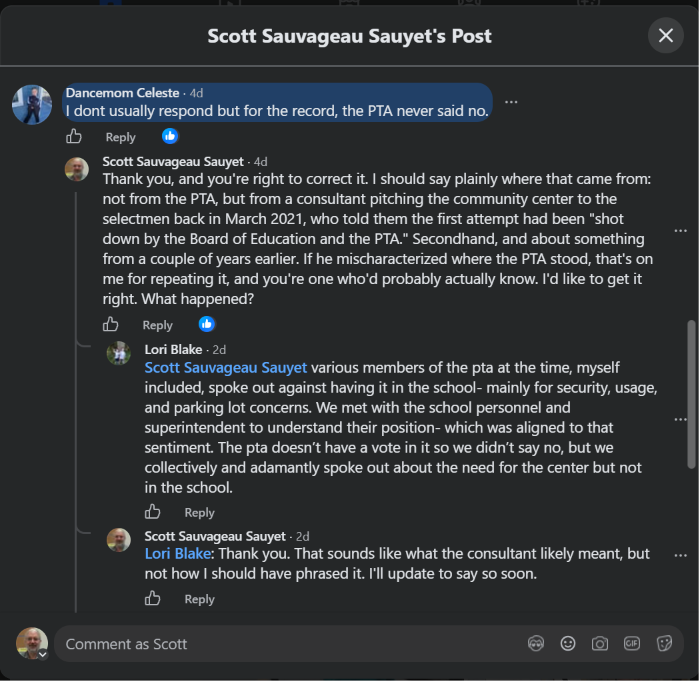
A public comment left on the "A Town Asset" series post in a town Facebook group. Lori Blake, identifying herself as a PTA member at the time of the senior-center siting discussions, responds to the series' statement that the town's request to use the school's unused floor space had been "shot down by the Board of Education and the PTA." She states that the PTA had no vote in the matter and so did not formally say no, but that its members, herself included, spoke out against siting the center in the school over security, usage, and parking concerns, and met with school personnel and the superintendent, whose position aligned with that view. This is a firsthand recollection stated publicly by a named participant, not a town record; it is cited as testimony to that effect, offered contemporaneously and under her own name, and it is the basis for the correction appended to the senior- center piece. Facebook comment permalinks are unstable and archive.org could not capture the page, so the linked image is a self-hosted screenshot preserving the comment as it stood; the original Facebook comment is at facebook.com/groups/2788103908136116/posts/4659730580973430 (comment_id 4660364534243368), which may or may not resolve for a given reader.
At the December 12, 2022 Board of Selectmen meeting the town administrator reported an upcoming planning and zoning hearing on "the zone change that will enable a community center to be built on the town's property," and that a surveyor had been researching the town's records and walking the School Road parcel (~39:39). At the January 9, 2023 meeting he reported that the survey was due and that he had filed the statutory 8-24 referral for the community center parcel "on behalf of the board of selectmen, from myself," which the commission approved (~1:45:54, ~1:47:51). Each of these steps was an ordinary, public municipal process. The Board of Education's own account, given the following June, is that its building committee had not met since May 2022, that it had "been in the dark," and that its first notice was a map; the First Selectman said at that meeting that he should have done a better job of inviting a board member onto the committee.
First Selectman Jeff Maguire and Selectwoman Paula King came to the June 14, 2023 Board of Education meeting for a conversation about the community center; the minutes record the chair welcoming them by name. He answered the board's written safety questions, then took up the memorandum of understanding the board's attorney had drafted. On the record he set out the town's position: "The town of Andover is the school district... The town owns all the land. The town owns all the buildings. The town is the owner of everything. There are no deeded properties to a school or to a board of education" (~38:30). Of the memorandum he said "it's not necessary that we really do that," while agreeing to review it, and said the town would go to planning and zoning and move forward (~39:38). Asked whether the school should budget to pave its own upper parking lot, he answered: "It should go to CIP... It's a town asset. This building is a town asset" (~54:01), and earlier, "It's all town money. I don't split hairs" (~50:58). He also told the board he does not tell the Board of Education how to spend its money, that he was not going to kill their budget, that he took responsibility for not having invited a board member onto the building committee, and he agreed to quarterly meetings between the boards. The board chair replied that there is a deeded school line on the site-plan map and that the board has statutory control of school property (~1:05:04). Official minutes: https://www.andoverelementaryct.org/images/boe/Minutes/BOE_Minutes_61423.pdf
At the June 12, 2023 Board of Selectmen meeting, with members of the school board and the superintendent present, the selectmen took up a list of safety and deed concerns the Board of Education had submitted about the community and senior center being built on the elementary school grounds. First Selectman Jeff Maguire, presiding, treated the concerns as matters for the architect, builder, engineer and fire marshal rather than for the board, and the project moved forward. He stated that the school building is "a town asset" and that "it's all the same pot of funds -- the school is town money, the roads are town money, the parking lot is town money" (~14:46). At the same meeting the board voted 4-0 to establish a separate AES Capital Fund. Video: https://www.youtube.com/watch?v=A-u_Seb_VrE
At the July 12, 2023 Board of Education meeting the board reported that the memorandum of understanding it had drafted, at a selectman's request, had been rejected -- not by a vote or a letter, but by the town administrator speaking at a planning and zoning meeting: "Eric Anderson said the town will not sign the MOU that we presented" (~37:52). A board member noted that three selectmen, including the First Selectman, were present at that meeting and none contradicted him (~38:10). The board had received no formal response from the Board of Selectmen to a document that board had asked it to produce, and voted to seek one in writing (~40:38). The board chair also reported that he had raised the town administrator's conduct with the First Selectman, who acknowledged it was not correct and said he would speak to him (~43:52), and that the First Selectman had invited him to the groundbreaking (~46:40).
The Andover assessor's records show the entire School Road complex titled to the Town of Andover: the elementary school parcel at 35 School Road (10.7 acres, use "Schools-Public," deed Volume 15 Page 131); the town hall at 17 School Road (0.92 acres, deed Volume 19 Page 151, acquired 1963); and the vacant lot behind the town hall where the community and senior center was built (3.0 acres, deed Volume 20 Page 272, acquired 1965). The school district holds no title to any of it, and has not for sixty years. No land was transferred from the school district to the town, because none was ever held by the district.
First Selectman Jeff Maguire and Selectwoman Paula King came to the June 14, 2023 Board of Education meeting for a conversation about the community center; the minutes record the chair welcoming them by name. He answered the board's written safety questions, then took up the memorandum of understanding the board's attorney had drafted. On the record he set out the town's position: "The town of Andover is the school district... The town owns all the land. The town owns all the buildings. The town is the owner of everything. There are no deeded properties to a school or to a board of education" (~38:30). Of the memorandum he said "it's not necessary that we really do that," while agreeing to review it, and said the town would go to planning and zoning and move forward (~39:38). Asked whether the school should budget to pave its own upper parking lot, he answered: "It should go to CIP... It's a town asset. This building is a town asset" (~54:01), and earlier, "It's all town money. I don't split hairs" (~50:58). He also told the board he does not tell the Board of Education how to spend its money, that he was not going to kill their budget, that he took responsibility for not having invited a board member onto the building committee, and he agreed to quarterly meetings between the boards. The board chair replied that there is a deeded school line on the site-plan map and that the board has statutory control of school property (~1:05:04). Official minutes: https://www.andoverelementaryct.org/images/boe/Minutes/BOE_Minutes_61423.pdf
At the August 9, 2023 Board of Education meeting the superintendent gave a detailed, contemporaneous account of what had happened to the school's paving project since the board voted 5-0 on June 14 to appropriate up to $120,000 to repave the upper parking lot and basketball court as a safety matter (~23:13). On July 27 the school's contractor applied for a standard town right-of-way permit and it was denied, on the grounds that the school needed to go through planning and zoning and wetlands. The planning and zoning chair then told her and the board chair that it was not a planning and zoning matter and they did not need to come before the commission; the wetlands commission wrote that it was not a wetlands matter. On July 31, at the First Selectman's request, the school met with the paver and public works, after which the town administrator sent new conditions: no permit unless the project was approved at a Board of Selectmen meeting, town-hired laboratories to test soil and asphalt compaction, paving-thickness monitoring, Cape Cod curbing, and public-works backfill. The paver, of forty years' experience, said he had not seen such conditions on a job this size. On August 4 the superintendent sent the town administrator and the First Selectman the sections of the town charter that except the board of education from those requirements, and received no reply. With the administrator away, she was told the only official who could issue the permit in his absence was the First Selectman; the board chair called him, and no permit issued. The board closed the upper lot for the school year (~23:41-36:02).
At the August 14, 2023 Board of Selectmen meeting First Selectman Jeff Maguire, presiding, took up the elementary school's upper parking lot. He reported meeting with the school board chair and the finance board chair, and set out the terms: the project would use the new town-held fund that the town administrator and the Board of Finance had established for the school's capital projects, and his one condition was that the work be performed to specifications laid out by the director of public works and the town engineer (~10:15). He said he had no objection to the project itself: if it is done in accordance with the engineer and public works, "I have no problem with the project moving forward," though he added it might not be the most useful project to do at the school (~11:41). The town administrator then set out the technical conditions at length: basin tops, reclamation depth, tack coating, indemnification, performance bonding, compaction and thickness testing, and public-works backfill.
Three days after the selectmen conditioned the paving permit, the Board of Finance held a special meeting to move the money. Asked directly by a Board of Education member whether the new fund was the school's or the town's, the town administrator answered: the "account is on the town side. The town controls that money as it rolls back. It was just designated. It comes back into the town and then becomes designated for a capital fund." Pressed further -- that it sounded as though the town would be in charge of what it was used for, rather than it being a capital account for the school -- he answered: "Correct... it's not at the complete discretion of the school" (~3:29-3:55 of part 2; the meeting was recorded in two parts, and this entry links the part carrying the exchange). Two things the town did in the school's favour at the same meeting: it agreed to pay for the materials- testing laboratory, the proctor and the monitoring, and to backfill behind the curbing at its own cost (part 1, ~15:37); and the finance board convened a special meeting on short notice specifically to keep the project moving. Part 1 transcript (public speak, the discussion, and the 4-0-1 vote): https://andoverct.info/reference/video/transcripts/zHh2bYvxWcI.html
At the September 13, 2023 Board of Education meeting the board learned the terms on which its paving project could go ahead. The town would not accept a check made out to the contractor; the money had to be payable to the Town of Andover. The mechanism, as the town administrator relayed it from the town attorney and the auditor: the school must vote to unencumber its own budgeted funds and return them to the town, "they have to put it in their general fund, and then they have to spend the money. It becomes their money first," after which the town would book the work as an education-related capital expense and pay the bill (~1:21:58, ~1:47:45). The school's own budget would then close the year showing a surplus of roughly $125,000 that it had not in fact saved (~1:49:43). The board chair said on the record: "it is ridiculous what has happened with regard to the denial of a permit with regard to paving in a spot in our school that is under our jurisdiction that requires that it be done for safety purposes and could have been done months ago before the school year even started" (~1:29:04). The board voted 4-3 to comply.
At the November 29, 2023 Board of Finance meeting, with the auditor present, the board worked through the statutory design of the new AES capital fund and stated the consequence plainly. On the difference between the school's existing 2 percent non-lapsing account and the new town-held capital fund: "I think what changes in terms of the statute is the authority to spend. So under the 2%, it should be the Board of Education" -- "under the capital, that would be the Board of Finance" (~24:41). The board noted that the school could have paid for the parking lot out of its own non-lapsing account, "we certainly could have done the parking lot and paid for it out of that account with their blessing," but that the school wanted to keep that as its reserve; and acknowledged that with the new fund "the downside with the schools [is] they don't have as much authority over that" (~28:04-28:59).
At the October 12, 2023 joint meeting of the three boards, a moderator asked the Board of Education directly whether the town had interfered in the application of its role. The board answered: "We were not able to get a permit to pave our upper parking lot over the summer, and therefore it is still sitting unpaved and dangerous for people to walk on," and "we were told about four different reasons for why we were not able to have that permit before we finally gave [in to] an agreement that we would give the money to the town" (~1:04:37-1:04:57). The town's answer, from the First Selectman: the town had not interfered on an operational level, and the issue was "the fact that we did not acquiesce [to] the way that you want to do a capital improvement project" (~1:06:59). He said the only condition requested was that public works and the town administrator create specifications so the job was done correctly, "that's what you and your board failed to do when you went around the [proper] process" (~1:39:25). The town administrator then set out the engineering substance behind the conditions.
At the December 4, 2024 joint meeting of the selectmen, the finance board and the school board, the dispute over the elementary school's capital projects played out at length. First Selectman Jeff Maguire told the Board of Education the school "is not a board of education building, it's a town asset, it's part of the capital," and that state law "says that the town owns the assets inside this building," while the board has "total control how you educate children" (~11:02-11:52). He demanded a five-year capital plan routed through the town's capital improvement committee, "just like every other group within this community" (~13:16). The Board of Education answered that the committee makes recommendations which then go to the selectmen for approval, so what was being proposed was that the school seek the selectmen's approval for its own capital money (~15:57). The superintendent set out the statutory position: by law the board of education "shall have the care, maintenance and operation of buildings, lands," and in other towns school capital does not go to the selectmen for approval (~28:47-43:07). Video: https://www.youtube.com/watch?v=-B9O-4anXqk
Reviewing the town's project list at the September 9, 2024 Board of Selectmen meeting, the town administrator gave an account of the elementary school's upper parking lot. He said the school board still very much wanted to redo it; that the previous year's bid put it at roughly $135,000; that "right now there would be the money set aside to do that"; but that "the school board has prioritized doing the internal work, plumbing work, to restore the bathrooms that have failed in the upper part of the building." The parking lot, he said, "could be done essentially at any time, we could schedule that for next spring, we just have to make sure that we have the funding to pay for it" (~32:18).
At the March 27, 2024 Board of Finance meeting the town administrator recounted the mechanics of the school's parking-lot money. He said that when the school wanted to do the parking lot the previous summer, what was agreed was that it transfer a check; that the town requested $130,000; that the school "originally wrote a check for like 124... which they then took back because they didn't actually have 124 to write"; and that the final figure was about $112,000 (~2:58). Board members confirmed the arrangement: the school transfers the money to the town, into the town-held capital account, with the town's $100,000 budget contribution added to it, because, as one member put it, the town "controls the account" (~5:55). Later in the meeting the board discussed the school's plumbing failure -- seventy-year-old cast iron pipe, three unusable bathrooms -- and concluded it was significantly more expensive and much more pressing than a parking lot, so it moved to first priority.
Presenting the FY2024-25 town budget at the April 24, 2024 Board of Finance public hearing, the board explained the creation of the AES Capital Fund on the record: "we have also set up a capital fund for the Andover Elementary School. This is new, hasn't been funded in the past, but the reality is that we need a capital expenditure fund for the AES school. We do not have any mechanism currently significantly in place to fund capital improvements to the school, and this has become a real issue. We've got some parking lot problems, we've got some other infrastructure problems that really need to be dealt with at AES" (~10:08). The statement establishes both that the school had no capital funding mechanism of its own, and that the parking lot was among the problems the new fund was created to address.
At the April 9, 2025 Annual Budget Meeting the Board of Finance chair explained how the elementary school's capital projects are funded: "Andover Elementary School Capital Fund. We established this last year, put about $100,000 of seed money in it. This was a problem prior because the elementary school did not have any way to fund major projects... they don't have a means to have a capital fund separately from the town, so we had to set one up in the town." He said the fund was not seeded again this year and is instead fed by the school's own surplus, about $360,000 returned after the audit (~15:46). He added that the surplus flows into the fund only by the town's yearly vote, and that if the town declined to permit it, the money "would then just be absorbed back into the town's funds" (~52:45).
Two weeks after the December 4 tri-board meeting, the Board of Finance adopted a usage policy for the AES Capital Fund. The fund is held on the town's books: the town "may choose to deposit money into this Capital fund through its budget process" (it put in $100,000 that year, the first), and the Board of Education "may also choose to deposit money from its budget," meaning its post-audit surplus, with all money in the fund to be spent on capital projects for the elementary school (~53:19-55:24). The policy was adopted subject to the school board's review and feedback (~63:54). Board members explained the fund's origin: the school, unlike the regional district, had never historically had a capital budget of its own, so its only vehicle to save for capital was its 2 percent non-lapsing account (~39:29).
At the December 4, 2024 joint meeting of the selectmen, the finance board and the school board, the dispute over the elementary school's capital projects played out at length. First Selectman Jeff Maguire told the Board of Education the school "is not a board of education building, it's a town asset, it's part of the capital," and that state law "says that the town owns the assets inside this building," while the board has "total control how you educate children" (~11:02-11:52). He demanded a five-year capital plan routed through the town's capital improvement committee, "just like every other group within this community" (~13:16). The Board of Education answered that the committee makes recommendations which then go to the selectmen for approval, so what was being proposed was that the school seek the selectmen's approval for its own capital money (~15:57). The superintendent set out the statutory position: by law the board of education "shall have the care, maintenance and operation of buildings, lands," and in other towns school capital does not go to the selectmen for approval (~28:47-43:07). Video: https://www.youtube.com/watch?v=-B9O-4anXqk
At the November 13, 2024 Board of Education meeting the board reported that it could not get a clear account of the AES Capital Fund. A member said she went to the town treasurer in person and then by email, copying both heads of the Board of Finance, and was told the fund "was not located in the town's stiff account" -- although, having reviewed the recordings of finance board and selectmen's meetings, "in those meetings it was stated that that was where said fund was going to be located" (~49:02). The school's statements showed accounts under other names, but nothing titled the AES Capital Fund (~50:04). On further inquiry the treasurer replied that the fund was a stand-alone fund with its own bank account, that the town had funded it for $100,000 for the 2024-25 fiscal year as listed in the town budget, but that "the funds have not been transferred yet into the separate bank account."
Discussing the town's short-term investment account at the July 8, 2024 Board of Selectmen meeting, the town administrator told the board the town had roughly $3.4 million in it and that the town should "try to have as much money... including the AES balance in that account so that we maximize our interest earning potential" (~71:16). He explained that one option would be to encourage the school to open its own investment account, though "technically a school is only supposed to be spending what is budgeted," so unspent money "should go back to the town anyway," and that the town could instead agree with the school board that such money automatically flow into the AES Capital Fund, which would mean "that much less money that we as a town have to put into that Capital fund" (~71:16-73:18).
Across the June 9 and June 12, 2025 Board of Selectmen meetings, First Selectman Jeff Maguire challenged the Board of Finance's authority to move the school's unexpended year-end appropriation into the AES capital fund, arguing the transfer was done incorrectly and should require a town-meeting vote. He restated his framing that the school is town property: "The school building is a town asset. The town hall is a town asset. The community center is a town asset," and that the capital fund "is a town account, not a board of education account." The superintendent objected on the record ("respectfully, Mr. Maguire, you're offering some misinformation... we have a good auditor who has done right by this town"). The town's auditor subsequently found no impropriety in the transfer. On June 12 the board voted to set a town meeting on the question.
On January 11, 2023 the Board of Education voted 7-0 to accept the solar power purchase agreement for the elementary school, after reviewing the rate, the escalator, the project cost and the twenty-year savings (~30:18-58:58). The town was not a party to it, there was no town meeting, and no town signature was required. Three weeks later the superintendent reported that "Jeff Maguire did do the notarized page that has to go through from the town for us to apply for that PPA application," and that the February deadline had been met (February 2, 2023, ~9:39).
At the January 13, 2025 Board of Selectmen meeting the board split over whether the town should involve itself in the elementary school's solar project. Selectman Anne Cremé argued it was not the town's business: "the solar is the school and the school is the one who's going to be working on that... it's simply the school's Authority," and "the Board of Education has control of the school building and we should not be usurping what the Board of Education should be working on" (~57:09-59:02). First Selectman Jeff Maguire, presiding, rejected that, challenged her for having voted against the solar referral at planning and zoning, and asked "who do you work for -- you work for the town of Andover or... the faction on the board of education that does not want to work with us" (~59:02). Selectman Jeff Murray then intervened, saying he supported the solar project but was concerned that solar companies overstate the savings they promise. Video: https://www.youtube.com/watch?v=BoLJQi4XujI
At the February 25, 2025 Board of Selectmen special meeting, the Board of Education, through its representative, asked the selectmen to schedule a town meeting specifically for the solar project at the school, separate from the town's other items (~1:20). The selectmen discussed whether the school's power purchase agreement should go to a town vote at all. One selectman argued the town had to vote because of the potential cancellation-penalty liability, saying the town meeting is the legislative body (~8:36). The board voted 4-0 to schedule a town meeting for March 13, 2025.
At the March 10, 2025 Board of Selectmen meeting, under the item on solar at the elementary school, First Selectman Jeff Maguire, presiding, objected that the power purchase agreement "was signed by the Board of Education already, which it shouldn't have been, so there has to be some amendment to that contract," and said he would request that something be drafted with the town attorney so the town could be brought into the agreement (~1:12:40). He framed the project as carrying a liability the town must control: "there is a capital liability on this, so we need to put a dollar number on it," and noted the cancellation penalties were high (~1:14:15).
At the March 13, 2025 special town meeting the sole substantive item was the rooftop solar project at Andover Elementary. The resolution approved the project subject to a second amendment to the power purchase agreement whose terms "shall include at a minimum the addition of the town of Andover to the agreement," together with preservation of the roof warranty and a fair- market-value buyout (~51:30). It passed 53 to 24 (~1:28:15). Asked directly whether any other town is also a signer on a school's power purchase agreement, the solar company's representative said he had never seen it (~47:25).
At the June 26, 2025 Board of Selectmen special meeting the sole action item was the elementary school's solar project, and the board voted 4-0 to approve the second amendment to the solar power and services agreement. First Selectman Jeff Maguire, presiding, ran the item; the town attorney reported that he had reviewed the amendment and coordinated with the Board of Education's own solar attorney before urging approval. The amendment reduced the panel count and adjusted the lifetime rate, still described as better than the district's current rate and held for twenty years. At the July 9, 2025 Board of Education meeting a district update reported that the solar amendment had been sent bearing the signatures of the board chair and the First Selectman.
At the January 12, 2026 Board of Selectmen meeting the board reviewed the contracting of the elementary school's bathroom renovation. The project had been expected to go out to a competitive request for proposals, but had become a design-build arrangement in which the school's engineering firm sought to act as general contractor and roll the trades into a single bid (~36:33, ~1:04:41). The school board's dedicated bathroom committee meeting of January 5, 2026 records the project's origin, a leak in May 2024 that proved to be a larger drainage failure, and the move to seek additional contractor bids.
At the October 9, 2025 Board of Education meeting First Selectman Jeff Maguire questioned the selection of the general contractor for the bathroom renovation. After the superintendent reported that the school's engineering firm, in a design-build arrangement, had recommended a general contractor with identified subcontractors, he pressed that the board had announced a general contractor with no cost figures attached: "if you're announcing the general contractor... What's the number? And you're all telling me we have no number." He argued that the town's prior capital projects had been managed by the town administrator, and that the boards should work together and use the expertise available.
At the December 17, 2025 Board of Finance meeting First Selectman Jeff Maguire questioned the bathroom-renovation spending and the process behind it, saying he would support the project but had "a problem with how we've been doing things." He challenged whether the work was needed at the school's current enrollment, and tied it to his objection that the school's unexpended funds had been moved into the capital fund without selectmen or capital-committee oversight. The finance board chair, Robert England, responded that the board weighs the whole town's needs and that he himself sits on the capital improvement committee.
Section 501 of the current Andover Charter provides that the First Selectman, or a designee who must be a Selectman, "shall be an ex officio member of all other town commissions, boards and agencies." This is the charter provision under which the First Selectman may sit with the Board of Finance and the Board of Education. The section grants the seat to the First Selectman or to a selectman designee.
A census of the attendance blocks of every Board of Finance minutes document in the town's archive. The First Selectman is not listed present at a single Board of Finance meeting from 2015 through 2024, across fifty-two readable meetings in the 2020-2024 stretch alone. He first appears on May 7, 2025, and from October 2025 forward he is present at most meetings, in consecutive months: October 22, November 19 and December 17, 2025, and January 28, February 25, March 24, April 1, May 6 and May 27, 2026. These minutes routinely name non-members in attendance, including the town administrator, the treasurer, the board clerk, Board of Education representatives, and, where applicable, "Public Present: none," which is what makes the earlier absence meaningful. Jeff Maguire has held the office of First Selectman throughout this period; the Board of Selectmen minutes of June 8, 2020 record him calling that meeting to order.
At the February 11, 2026 Board of Education meeting the superintendent said on the record that for six years the First Selectman, sitting ex officio, has publicly questioned her, the board, the teachers and the principal "every single time" (~2:00:39). The First Selectman replied that he "just started to attend board of education meetings in October," pointing to the recordings for the earlier years (~2:01:23). Asked as the ex officio member where he would cut the school's budget, he restated his standing request for detailed line-item information and named salaries as the main increase (~2:19:13).
At the May 16, 2022 Board of Selectmen meeting, during a presentation by the Economic Development Commission, a former selectman of nine years described from her own service how the coordinating work between the board and the town's committees used to be done: selectmen assigned themselves as liaisons to committees, attended the meetings, and reported back to the board once a month with liaison reports. She added, "I find that missing in the Board of Selectmen now" (~19:21). She and others proposed quarterly meetings of committee chairs to restore the information flow. Her account concerns liaisons to town commissions generally.
Nominated from the floor for a vacant Region 8 (RHAM) Board of Education seat, a candidate described his prior town service: four budget cycles on the Board of Finance, during part of which "I was liaison to the RHAM Board of Education," sitting in on teacher contract negotiations, plus three years on the capital improvement committee (~1:20:07, ~1:22:07). The liaison he describes is to the regional board, not to the Andover Board of Education.
Two things of record at the October 27, 2021 Board of Finance meeting. Reaching the standing item for liaison reports, the presiding member said "I think typically the only liaison committees we have are the community center and also CIP" (~2:27:13): the finance board had no liaison to the Andover Board of Education. Separately, in open discussion, the presiding member reported that the Board of Selectmen had asked the finance board to have a representative available for discussions of theirs that might go into executive session, and the board agreed.
At the February 11, 2026 Board of Education meeting the superintendent said on the record that for six years the First Selectman, sitting ex officio, has publicly questioned her, the board, the teachers and the principal "every single time" (~2:00:39). The First Selectman replied that he "just started to attend board of education meetings in October," pointing to the recordings for the earlier years (~2:01:23). Asked as the ex officio member where he would cut the school's budget, he restated his standing request for detailed line-item information and named salaries as the main increase (~2:19:13).
At the March 11, 2026 Board of Education meeting the chair read into the record two letters sent to the full board. The first, attributed on the record to First Selectman Jeff Maguire and sent by way of a law firm, posed questions specifically about the superintendent's contract.
At the October 9, 2025 Board of Education meeting the board entered executive session at about 9:23 PM to discuss the superintendent's contract, "which is up this year," and resumed the recording at 10:01 PM. The chair then asked only for other action items and the meeting moved on. No public vote on the contract appears on the record of that meeting. The recording was running when the board returned; what is absent is the vote, not the recording. The contract was subsequently affirmed by a recorded public roll- call vote on March 11, 2026.
At the April 19, 2023 Board of Education meeting the board went into executive session at 9:07 PM to discuss the superintendent's contract, came out at 9:55 PM, and immediately took a public vote: a motion to accept the terms of the proposed renewal of the superintendent's contract for the 2023-24, 2024-25 and 2025-26 school years, as discussed in executive session, carried 7-0-0. The vote is on the recording (~2:06:40) and is written into the official minutes. It is the renewal that was due to expire in June 2026, which is why the contract was "up this year" in October 2025.
At the March 11, 2026 Board of Education meeting the board entered executive session to discuss the superintendent's contract, resumed with the recording running, and took a public roll-call vote to proceed with the contract as written from its October meeting. One member abstained, having been absent in October. The vote is on the public record.
A compensation study comparing Andover's superintendent pay with essentially every Connecticut public school district operating only elementary grades: 45 districts, less Norwich as structurally unlike. Contract data was collected for 39 of them, from town and district websites, from scanned public postings, and by records requests to town clerks, and the contracts themselves are published with the report. All figures are cash compensation (salary plus any board-paid annuity, longevity bonus and fixed allowances) normalized to a full-time-equivalent 260-day year, because Connecticut superintendent contracts range from a few days a week to full-time regional posts. Andover employs its superintendent at 0.6 full-time-equivalent and pays $90,000 in salary plus a $10,000 retirement contribution, a total of $100,000; she serves Scotland for the remaining 0.4 under a separate contract with that town. Normalized to full time, Andover's rate is $166,667. Among peers with current contracts Andover ranks 23rd of 24, against a peer median of $193,157. The only district paying less is Eastford, whose superintendent works 104 days a year. The study also finds that pay in this cohort is essentially uncorrelated with district enrollment. It states its own limitation: current contracts for five further peer districts have not yet been located, and one could come in at or below Andover's rate.
At the November 12, 2025 Board of Education meeting the superintendent addressed a records request from First Selectman Jeff Maguire consisting of four spreadsheets seeking preschool cost data, including each student's town of residence and the tuition paid, together with staff insurance enrollment. Present as the ex officio member, he pressed the request on the record: he said he had listed the children only as student one through sixty-four, asked why the data could not simply be redacted, and argued that the board could not have analysed whether the preschool is costly to the town "without getting the details," and cannot truly evaluate the program without them.
The federal statute protecting the privacy of student education records. Where a request for information would resolve to an identifiable student, FERPA requires a school district to withhold it.
The FERPA regulation defining "personally identifiable information" to include not only direct identifiers but indirect ones, and any information that, alone or combined with other information a reader already has, is linked or linkable to a specific student such that a reasonable person in the school community could identify that student with reasonable certainty. This is the legal basis for the principle that an aggregate taken over a sufficiently small group is not truly anonymous.
The confidentiality provisions of the Individuals with Disabilities Education Act (34 C.F.R. 300.610 through 300.627), which extend FERPA-style protection to personally identifiable information about children with disabilities.
The collective bargaining agreement covering the district's certified staff, setting salaries and the structure of insurance and benefits. It defines the benefit choices, plan tiers and cost shares that make an aggregate benefit figure taken over a small group of named positions reversible to individuals.
The collective bargaining agreement covering the district's non-certified staff, including paraprofessionals, setting classifications, wages and insurance. Together with the teachers' contract it defines the benefit structure for the preschool's paraprofessional positions.
The Connecticut Freedom of Information Act provision governing public employees' personnel, medical and similar files, and the process by which disclosure that would constitute an invasion of personal privacy may be objected to. It is the state-law basis on which a district withholds benefit detail that would identify individual employees.
The HIPAA definitional provision. Information a town holds as an employer, in payroll and budget records, is treated as employment records, which HIPAA's own definition of protected health information excludes. HIPAA is the law most often reached for in a health-privacy argument, and it is generally not the one that governs here: the protection of employee benefit detail rests on Connecticut's freedom of information statute, and the protection of student information rests on FERPA and IDEA.
The federal agencies' joint guidance establishing the boundary between the two regimes: HIPAA's definition of protected health information excludes records covered by FERPA, so a student's school health record falls under one regime rather than both.
At the same meeting the superintendent explained on the record why the four- spreadsheet request could not be filled. Under FERPA, student financial records, including tuition payment records and who has or has not paid, are protected. Under Connecticut's freedom of information statute, confidential student records are withheld. And which staff are enrolled in the town insurance plan, what coverage they have, whom they insure and whether they decline it, is protected employee information. She stated the re- identification problem directly: even listing students by number, adding town of residence and tuition paid, set against the small size of the classes, makes individual children identifiable.
At the February 11, 2026 Board of Education meeting the First Selectman, sitting ex officio, said his "biggest issue" with the school budget is the preschool and that he focuses on it, and questioned whether preschool is still mandated (~1:47:30). Pressed later on where he would cut, he pushed for line-item detail and framed the increases as salary-driven (~2:19:13). The superintendent answered on the record that none of the roughly $499,000 budget increase is attributable to the preschool, and that recent enrollment growth splits roughly evenly between the elementary grades and the preschool (~1:39:40, ~1:59:46).
At the February 25, 2026 joint budget meeting of the finance and selectmen's boards, First Selectman Jeff Maguire pressed the preschool as an out-of-town cost question, asking whether residents are paying for out-of-town students and arguing the tuition does not cover the cost: with roughly fourteen out- of-town or staff children among about sixty-eight preschoolers, "they're paying at a maximum $6,000 of tuition, you're not covering your costs," and "a standard pre-K from a private business is going to be $12,000, you're charging six." He told the finance board, "you guys have to get the proof." The superintendent and board members answered on the record.
At the March 11, 2026 Board of Finance budget meeting the preschool was discussed at length. One member said she had "questions about the fact that we have no idea how much the taxpayers are paying for preschool," and that out-of-town families "are not coming here for any other reason" than the full-day preschool and its wraparound care (~2:11:36-2:13:24). Another member set out the empty-seat logic unprompted: "when you put together a preschool class, you look at how many Andover kids there are, and then you sprinkle in out of town kids to fill that room." The First Selectman was not the speaker on either side of this exchange.
The superintendent and the Board of Education chair answered the Board of Finance's questions about the preschool in detail, on the public record, in February 2021. Out-of-town children are admitted because the Smart Start grant requires an income mix the town alone cannot supply, so the admissions serve the grant's requirements (~1:13:35). Special-education slots pay no tuition, by law; the remaining slots pay full tuition (~1:14:52). Tuition had been raised sharply over the preceding two years and was benchmarked against neighbouring districts, topping out at the formulaic maximum (~1:16:03, ~1:20:18). The program also exists in part to stop the district losing children to magnet schools. Asked whether a large number of out-of- town children would make money for the program, the answer on the record was that it would not: once another classroom has to be opened, the revenue no longer covers the cost (~1:12:28).
In the FY2022-23 budget presentation to the Board of Finance, the superintendent walked through the preschool's grant lines and said that this is "really why when we say preschool, we say pays for itself between the tuition and" the grants (~14:01). She named them: the Smart Start grant pays the preschool salaries; IDEA funds pay the paraprofessional salaries; school readiness money funds sixteen slots and the grant-compliance liaison.
At the January 17, 2024 Board of Education budget workshop the superintendent set out the preschool arithmetic: the third preschool classroom was added because Andover's own enrollment required it, and out- of-town children are admitted afterwards, to fill what is left. "If we had unused slots that were available to our extended program, we could fill them with out of towners, and those out of towners would be full tuition rate" (~40:36-41:28). At the January 24 workshop the board confirmed the program's cost structure: the preschool sits outside the general fund, funded by school readiness money, Smart Start money and tuition.
At the January 14, 2026 Board of Education meeting the superintendent explained that the district began accepting out-of-town preschoolers about two years ago to fill otherwise-empty seats: adding a fourth preschool class left seats unfilled, and out-of-town children, who pay full tuition of $6,000, keep the room sustained as in-town enrollment grows (~59:37). Nine out-of-town children were enrolled this year; with more Andover residents enrolling, four are projected for next year.
At the March 4, 2026 Board of Finance budget meeting the superintendent explained the preschool's finances: tuition is $6,000 per child, matching the state early-start reimbursement rate and unchanged over her tenure; the eight preschool staff salaries are covered by roughly $440,000 of combined grant funding plus that tuition; and without the preschool the district would still owe mandatory special-education services for those children, an estimated $300,000 carried in the general fund with no offsetting tuition, because special-education students pay no tuition by law.
The preschool finance sheet in the April 8, 2026 Board of Education packet, showing the program's anticipated revenue for the year: local tuition of $247,986, an Early Start grant of $123,000 and a Smart Start grant of $65,000, alongside the program's salary lines. The packet is a scanned document; the revenue totals were verified against the page image.
At the May 14, 2025 Board of Education meeting the superintendent gave a detailed public account of how the elementary school receives and spends its money, in response to a newspaper insert that had made claims about the school's finances. She said the school's separate bank account and monthly allowance were established at the First Selectman's request: he asked her to open a separate account for the school, and the town would give it an allowance, as it does for the regional district (~20:47). She described the mechanics as an electronic transfer of about $434,000 in ten payments, July through April, with none in May or June. In the same meeting she set out the preschool's out-of-town admissions logic: a room the school is running anyway has empty seats, an out-of-town child cannot be placed here for special education, and such a child pays full tuition (~1:24:32).
The official results, as posted by the town, of the May 5, 2026 referendum. At the first referendum of the cycle the town budget, which carries the elementary school's appropriation, went to the voters as a single question, and it failed, 331 YES to 451 NO. Two advisory questions asked whether the town and school budgets were too high, too low, or about right. The RHAM operating budget passed in Andover, 390 to 379, and the RHAM capital budget failed, 377 to 395; both failed region-wide. After the defeat the town and school budgets were bifurcated for the votes that followed.
The official results, as posted by the town, of the May 26, 2026 referendum, the first after the budgets were bifurcated. The town budget passed, 412 to 367. The elementary school's budget, reduced to a 9.82% increase, failed, 343 YES to 431 NO. The RHAM operating budget passed in Andover, 417 to 360, but failed region-wide; the RHAM capital budget passed, 424 to 360.
The official results, as posted by the town, of the June 16, 2026 referendum. The elementary school's budget, reduced to a 6.0% increase, passed, 420 YES to 317 NO. The RHAM operating budget passed, 479 to 252, and passed region-wide. This is the vote that settled the budget the school operates under in FY 2026-2027.
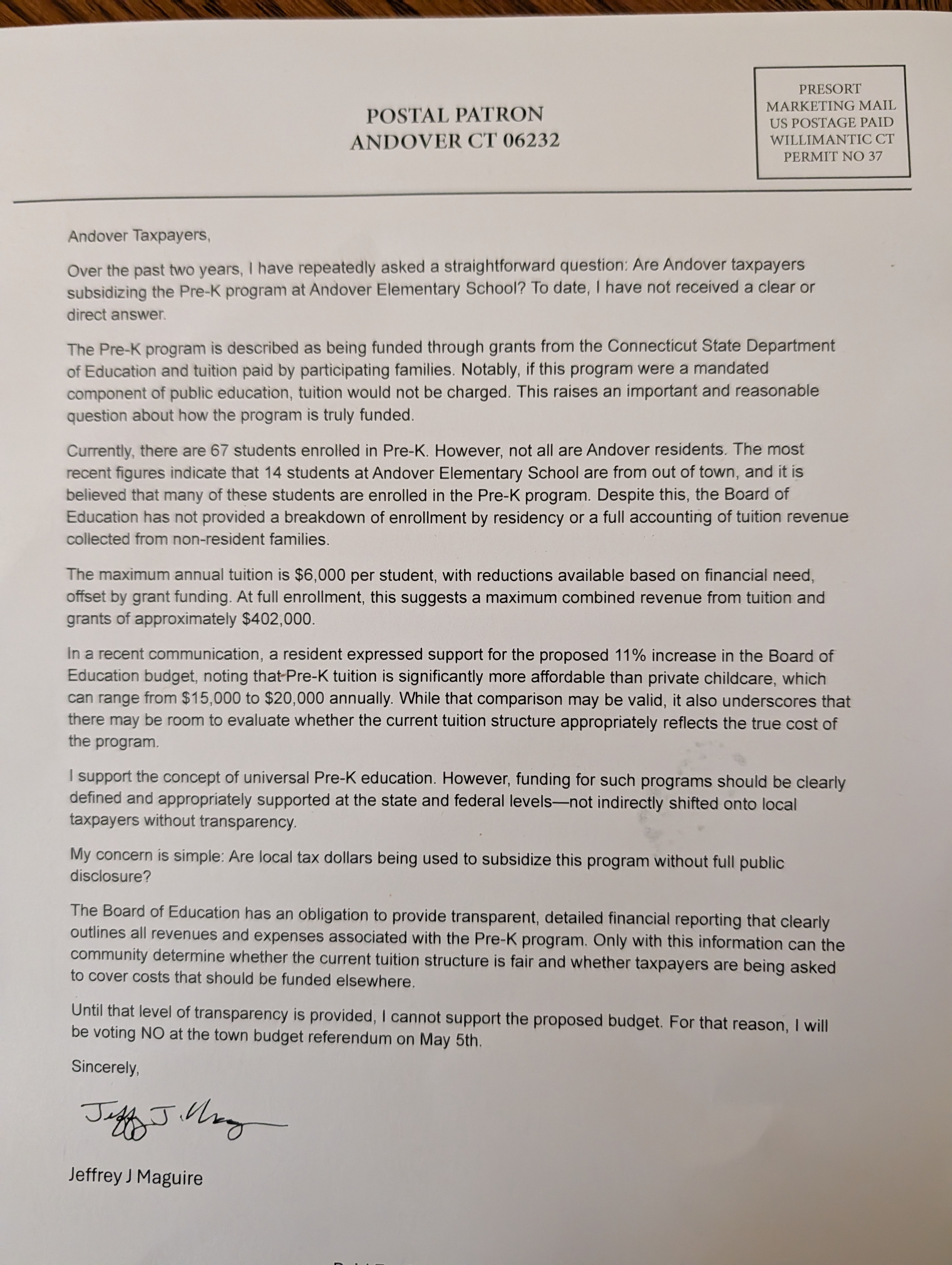
A single-page letter mailed to every Andover address ("POSTAL PATRON, ANDOVER CT 06232", presorted marketing mail), arriving in the days before the May 5, 2026 budget referendum. Addressed to "Andover Taxpayers," it asks whether taxpayers are subsidizing the elementary school's Pre-K program, cites 67 enrolled students and 14 out-of-town students at the school, reasons from a $6,000 maximum tuition to a combined revenue ceiling of roughly $402,000, and calls on the Board of Education to publish a full accounting of the program's revenues and expenses. It closes: "I will be voting NO at the town budget referendum on May 5th." Signed Jeffrey J Maguire; the foot of the page carries "Paid For by Jeffery J Maguire." Nothing on the letter identifies the writer as First Selectman.
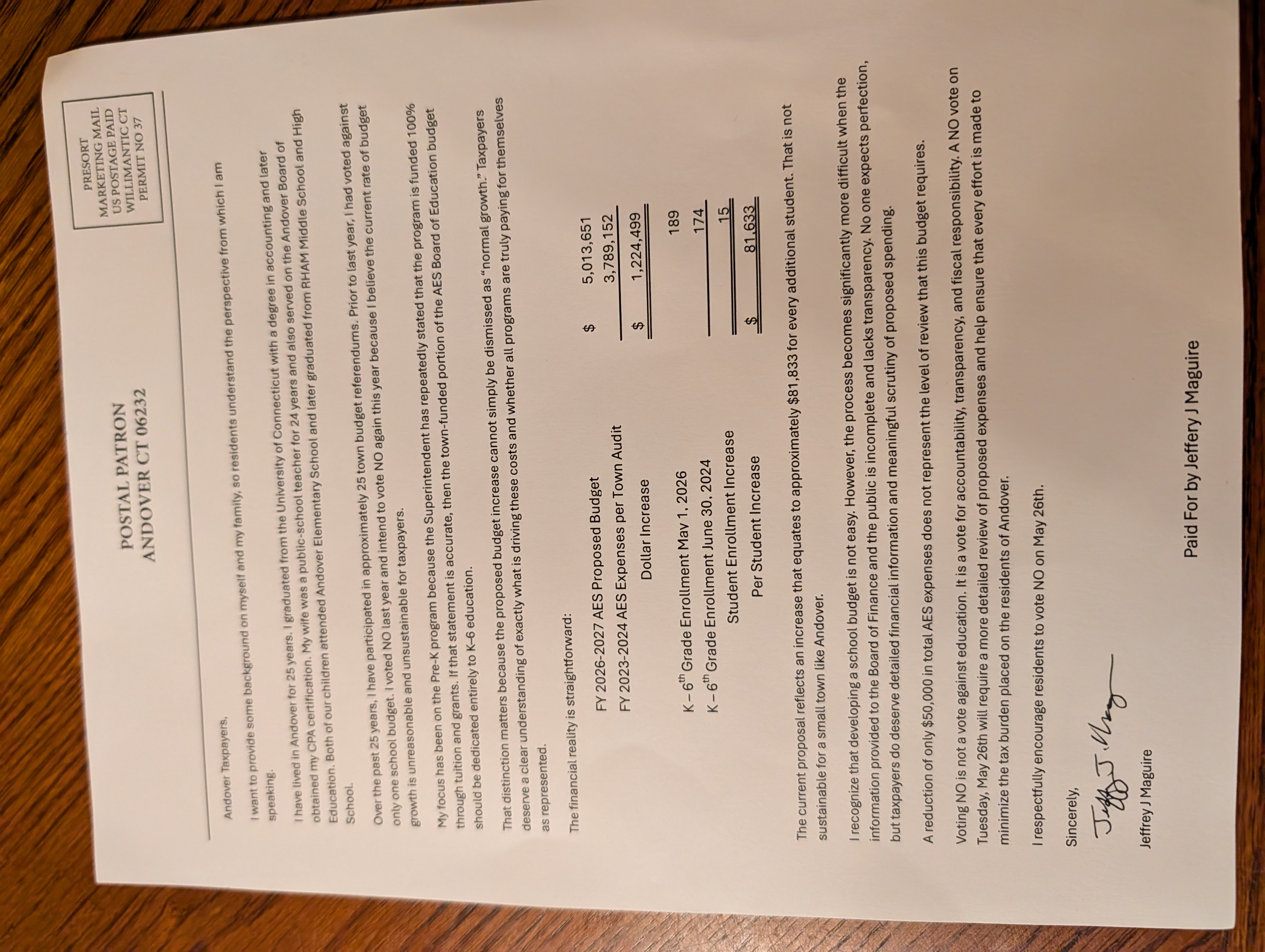
A single-page letter mailed to every Andover address, arriving May 20, 2026, six days before the second budget referendum. It opens with a personal introduction: twenty-five years in Andover, a University of Connecticut accounting degree and CPA, a wife who taught public school for twenty-four years and served on the Andover Board of Education, children through the local schools. It states that in roughly twenty-five town budget referendums he had voted against only one school budget before last year, and that he voted NO last year and intends to again. It sets the FY 2026-2027 proposed budget ($5,013,651) against FY 2023-2024 audited expenses ($3,789,152), a $1,224,499 increase, against a K-6 enrollment rise of 15 students, and derives approximately $81,633 per additional student. It urges a NO vote on May 26. Signed Jeffrey J Maguire, with "Paid For by Jeffery J Maguire" at the foot. Nothing on the letter identifies the writer as First Selectman.
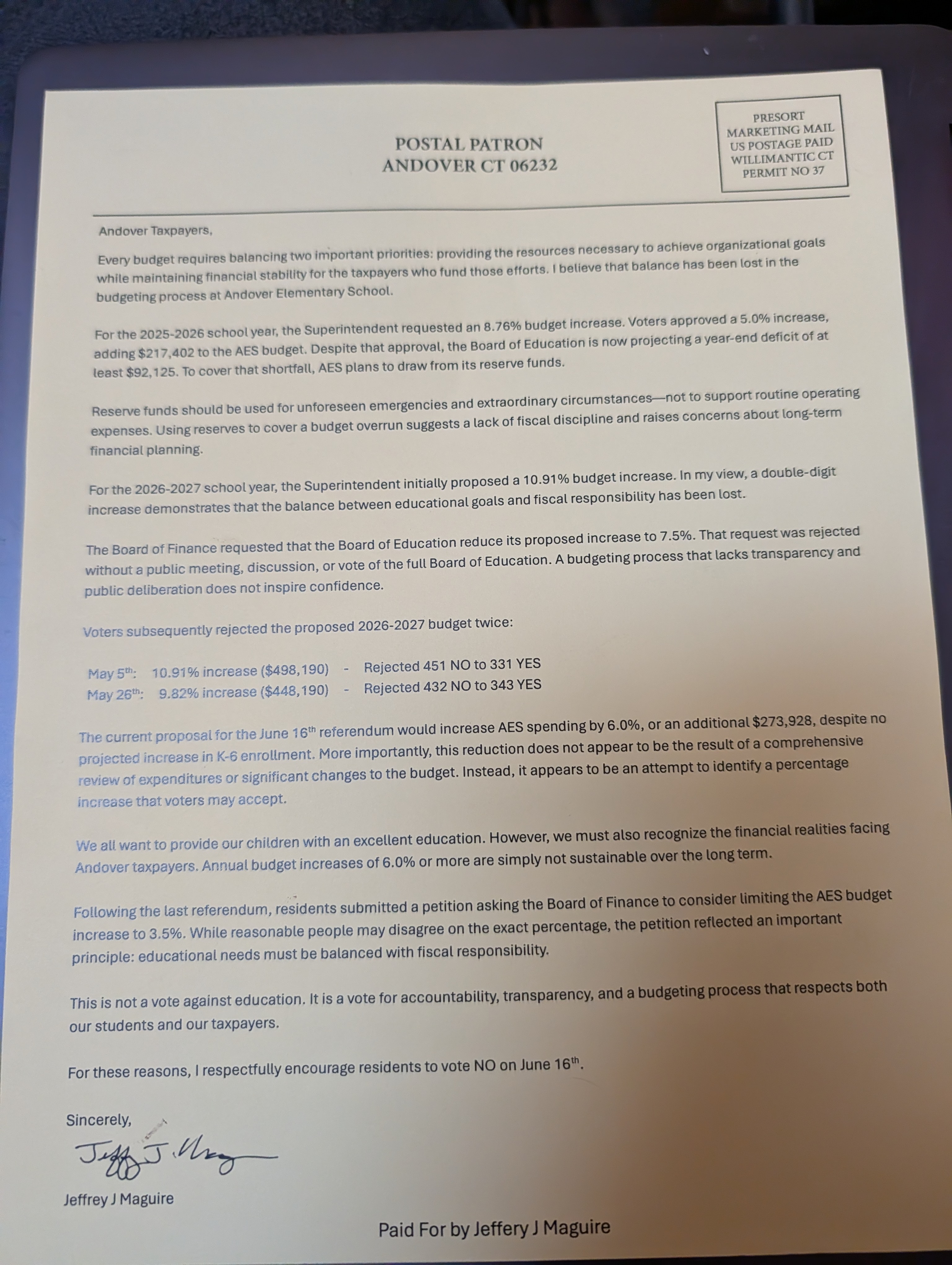
A single-page letter mailed to every Andover address, arriving June 12, 2026, four days before the third budget referendum. It recites the two defeats to date: May 5, a 10.91% increase ($498,190), rejected 451 NO to 331 YES; May 26, 9.82% ($448,190), rejected 432 NO to 343 YES. Of the third proposal, a 6.0% increase ($273,928), it says the reduction "does not appear to be the result of a comprehensive review of expenditures" but "an attempt to identify a percentage increase that voters may accept," and argues that "annual budget increases of 6.0% or more are simply not sustainable over the long term." It notes a resident petition asking the Board of Finance to consider limiting the increase to 3.5%, states "Voting NO is not a vote against education," and urges a NO vote on June 16. Signed Jeffrey J Maguire, with "Paid For by Jeffery J Maguire" at the foot. Nothing on the letter identifies the writer as First Selectman.
The official results, as posted by the town, of the June 16, 2026 referendum. The elementary school's budget, reduced to a 6.0% increase, passed, 420 YES to 317 NO. The RHAM operating budget passed, 479 to 252, and passed region-wide. This is the vote that settled the budget the school operates under in FY 2026-2027.
The recording of the July 23, 2025 Board of Finance meeting, at which the board took up the elementary school's levy schedule (agenda item four, ~2:35) and adopted it unanimously (~16:36). The finance officer explained the board's practice: the district does not submit a broken-out schedule the way the regional district does, so the board divides the appropriation into equal monthly payments. Asked "Has it always been 10?", the answer on the record was that this is "only the third year we did this, because before that we just paid their expenses directly. We had a combined checking account" (~3:40). Video: https://www.youtube.com/watch?v=6KKKZq0tsr4
The minutes of the July 24, 2024 Board of Finance meeting, carried in the following month's packet, record the elementary school's levy schedule "to be paid July 2024 through April 2025," presented by the town administrator. A motion to accept the schedule as presented was made, seconded, and carried 6-0-0.
The minutes of the July 23, 2025 Board of Finance meeting, carried in the following month's packet, record the item as "Levy Schedule for AES Payments -- proposed schedule provided in packet, 10 equal payments from July to April." The motion to accept the schedule as presented was made by board chair Robert England, seconded, and carried 7-0-0. It is the vote behind the schedule and figures in the July 23 packet.
The Board of Finance packet for July 23, 2025 contains the motion text and the payment table for the 2025-2026 levy schedule for the Andover Board of Education: ten equal monthly payments, July through April, of $456,546 each. This is the document that sets out how the school's approved budget is actually released to it, and the exact monthly figure.
The July 1, 2026, 11:02 AM email from First Selectman Jeff Maguire to Board of Education chair Caitlin Greenhouse, copied to Board of Finance chair Robert England and blind-copied to the Town Treasurer and the Town Administrator, announcing that effective July 1, 2026 the Town would be implementing a revised funding process for the AES operating budget. States its purposes as strengthening cash management, maximizing the investment of Town funds, and eliminating reconciliation issues identified during the Town's annual audit. States that the Town "has deposited" $100,000 into the Andover Public School Operating Account (M&T Bank, account number redacted), effective July 2, 2026, to initiate the new process, and sets out the replacement mechanism: the AES business manager submits weekly check registers and payroll registers, reviewed and approved, to the Town Treasurer, Assistant Treasurer and Town Administrator; the Town then transfers funds equal to the approved disbursements; the business manager prepares a monthly reconciliation; and the Treasurer ensures cumulative funding does not exceed the approved operating budget. Produced in the Town's July 16, 2026 records response, production pages 12-13.
From the Town's July 16, 2026 records response. July 8: the Board of Education's attorney, Peter J. Murphy of Shipman & Goodwin, writes the First Selectman and Town Administrator that the Board's approved budget is $4,839,390, that a payment of approximately one tenth was due July 1, and that "the Board received a payment of only $100,000"; that the "Approval Process" violates the Board's rights under Conn. Gen. Stat. 10-222 and has no authority in the Town Charter, whose expenditure provisions exempt the Board of Education; and that the First Selectman's own July 6 email "demonstrates that the Board of Selectman never discussed nor approved the Approval Process." It demands the remainder of the July payment (pp. 47-51). July 9: Superintendent Bruneau formally requests the remaining balance be transferred that day (p. 53). July 10: the attorney repeats the demand to the Treasurer and Town Administrator and notes the July 13 Board of Selectmen agenda item, whose packet contains no documentation of the procedure being acted on (pp. 52-58). Sunday, July 12, 8:46 PM: Town Treasurer Lisa Jablonski reports she has made the transfer, after 5 PM, expected to post around July 14 -- the night before the Board of Selectmen's July 13 meeting (p. 59).
Discussing the town's short-term investment account at the July 8, 2024 Board of Selectmen meeting, the town administrator told the board the town had roughly $3.4 million in it and that the town should "try to have as much money... including the AES balance in that account so that we maximize our interest earning potential" (~71:16). He explained that one option would be to encourage the school to open its own investment account, though "technically a school is only supposed to be spending what is budgeted," so unspent money "should go back to the town anyway," and that the town could instead agree with the school board that such money automatically flow into the AES Capital Fund, which would mean "that much less money that we as a town have to put into that Capital fund" (~71:16-73:18).
The correspondence, from the Town's July 16, 2026 records response, that establishes in writing that no board voted on the funding change. June 22: the First Selectman sends both board chairs a written "Proposed AES Operating Account Structure" -- the same account, the same weekly registers (pp. 6-7). June 23: BOE chair Caitlin Greenhouse declines in writing; the board is "likely not interested in pursuing this proposal at this time," and she will share it with the full board (pp. 8-9). June 24: he forwards the proposal to all six Board of Finance members "so that we can have a discussion" (pp. 10-11); no meeting of any board takes it up. July 1, hours after the announcement: the chair replies that no responsibility of a First Selectman allows this "without BOF, BOS and BOE approval," that AES should have received one tenth of its operating budget that day, and that the board has reached out to its attorney (pp. 14-15). July 2: BOF chair Robert England: "It is very unclear to me that this is right and proper. First, did the BOS vote on this? The BOF certainly didn't," quoting and attaching the July 23, 2025 minutes of the 7-0 levy-schedule vote (pp. 27-30). July 3: Selectman Anne Creme: she does "not agree," a change "would require a discussion and vote by the Board of Finance and the Board of Education," "The BOS has not discussed or voted on this new process," and "I think you overstepped your role" (p. 31). July 6: the First Selectman himself, in writing: "The Board of Selectmen has not yet voted on this procedural change... Until such time, I am responsible for implementing this change" (p. 38) -- while, the same morning, the change has become "the proposed funding procedure," which the full Board of Selectmen "will have the opportunity to discuss, modify, or affirm" at its July 13 meeting (pp. 32-37).
The posted agenda for the regular meeting of the Board of Selectmen on Monday, July 13, 2026. The most prominent items were the appointments of new selectmen to replace Carol Lee and Jeff Murray. But also on the agenda: "Discussion and Action on AES Operating Budget Funding Procedure."
The recording of the Board of Selectmen's July 13, 2026 meeting. At about 7:03 the First Selectman moves to delete the item "Discussion and Action on AES Operating Budget Funding Procedure" from the agenda, and the meeting proceeds without it.
The Town's independent auditor, a partner at Mahoney Sabol & Company, LLP, presented the fiscal 2025 audit to the Board of Finance and then answered questions about the July 1 change to the elementary school's funding. Four things are on the record. (1) THE FINDING: he reported one finding rising to a material weakness, the reconciliation of the town's general ledger with the school district's, and read out its recommendation: that the town "no longer records balances and activities that are already accounted for by the school district," that it "limit its accounting to transactions that involve direct financial activity between the town and the school district," including "appropriations, transfers, reimbursements, or shared service costs," and that "the school district continue to provide the town with its monthly financial reports" (~7:15). (2) THE PRIOR-YEAR SCHOOL FINDING IS CLEARED: the previous year's significant deficiency over bank and interfund reconciliations at the school district "has not been repeated" (~5:35); the corrective action plan was filed with the state Office of Policy and Management (~8:50). (3) WHO DECIDES: asked directly about the funding change, he said he had spoken with the superintendent and the first selectman, had no conceptual objection to a cash management policy that maximizes interest, but that neither state statute nor the town charter addresses the question; his recommendation was that it be "a board policy" approved by the Board of Finance, providing the parameters within which the administration sets procedure (~46:42), because "the question is who ultimately has the authority to make those decisions," and such a policy "certainly could include how the board of education... ultimately gets funded" (~48:21, restated ~57:32). (4) THE FIRST SELECTMAN'S OWN ACCOUNT: he told the board he was the author of the change, that "yes, I'm driving this, but it's not because of anything nefarious," and that he had never commented on the school's expenses other than the budget (~54:14); and that he cannot tell the Board of Education what to do, that the finance board cannot either, and that the board "can do whatever they want with their funded balance" (~54:52). SPEAKER IDENTITY CONFIRMED by Scott, 2026-07-24: Robert England (BOF chair), Jeff Maguire (First Selectman), Michael J. VanDeventer (auditor), Caitlin McIntosh Greenhouse (BOE chair). The 52:44-55:33 stretch is Maguire; 55:33-56:00 is the auditor. Video: youtube.com/watch?v=nqOKqiLFcGo.
The Town's audited financial statements for the year ended June 30, 2025, issued by Mahoney Sabol & Company, LLP and dated April 22, 2026. The Schedule of Findings reports one financial statement finding. Finding 2025-001, "Material Weakness in Internal Control over Financial Reporting - Reconciliation of the Town's and the School District's General Ledgers," states as its condition that "the Town's general ledger is not currently integrated with the School District's general ledger," that journal entries are required to reconcile the two, and that "the Town's year-end closing entries to record the School District's balances and activities were incomplete." Cause: "Lack of reconciliation controls." Effect: "Inaccurate financial reporting." Repeat finding: yes. The auditor's recommendation, in full: "We recommend that the Town no longer record balances and activities that are already accounted for by the School District. The Town should limit its accounting to transactions that involve direct financial activity between the Town and the School District. These may include appropriations, transfers, reimbursements, or shared service costs. In addition, we recommend that the School District continue to provide the Town with monthly financial reports to ensure that the Town remains informed about the School District's fiscal status." Views of responsible officials: "Management agrees with the finding and intends to take corrective action to address the deficiency." The same schedule records that prior year finding 2024-002, the significant deficiency over bank and interfund reconciliations, "is no longer being reported." Filed with the State of Connecticut Office of Policy and Management; the original can be retrieved by the public from OPM's Electronic Audit Reporting System at ears.opm.ct.gov, under Public Search, Audit Reports, entity Andover, year 2025.
The Town of Andover's corrective action plan for the fiscal 2025 audit, signed by the Town Administrator and addressed to the Municipal Finance Services Unit of the State of Connecticut Office of Policy and Management, dated May 6, 2026. It addresses Finding 2025-001, the material weakness in the reconciliation of the town's and the school district's general ledgers. Statement of concurrence: "Management of the Town concurs with the finding." Corrective action, in full: "The Town will no longer record balances and activities that are already accounted for by the School District. The Town will limit its accounting to transactions that involve direct financial activity between the Town and the School District. The Town will reconcile interfund transactions and balances monthly and will annually reconcile General Fund expenditures to the School District's accounting system." Projected completion date: June 30, 2026. The plan contains no reference to changing how or when the school district receives its appropriation, and no reference to check registers, payroll registers, or receipt-conditioned disbursement. Filed eight weeks before the First Selectman's July 1, 2026 email (1087), which states as one of its purposes the elimination of reconciliation issues identified during the town's annual audit. Retrievable by the public from OPM's Electronic Audit Reporting System at ears.opm.ct.gov, under Public Search, Corrective Action Plans, entity Andover, year 2025. Scanned image PDF; text above transcribed by OCR and checked against the page images.
The Town of Andover's corrective action plan for the fiscal 2024 audit, filed with the State of Connecticut Office of Policy and Management. It carries two plans. The town's plan for Finding 2024-001, the material weakness in the reconciliation of the town's and the school district's general ledgers, is word for word the plan filed again a year later (1102): stop recording balances already accounted for by the school district, limit town accounting to direct financial activity between the two, reconcile interfund transactions and balances monthly, reconcile General Fund expenditures to the school district's accounting system annually. Contact listed: the Town Treasurer. Separately, the school district filed its own plan for Finding 2024-002, the significant deficiency over bank and interfund reconciliations at the school district: bank reconciliations had previously been performed outside the accounting system, the district had begun using the accounting system's reconciliation feature and implementing monthly reconciliations of all interfund accounts, and was considering a financial consultant to support the business manager. Projected completion date: June 30, 2026. The fiscal 2025 audit reports that 2024-002 is no longer being reported (1101); 2024-001 repeated as 2025-001. Retrievable by the public from OPM's Electronic Audit Reporting System at ears.opm.ct.gov, under Public Search, Corrective Action Plans, entity Andover, year 2024. Scanned image PDF; text above transcribed by OCR and checked against the page images.
First Selectman Jeff Maguire's July 2, 2026, 3:35 PM email, responding to Board of Education chair Caitlin Greenhouse's objection of the evening before and sent to the full distribution her reply had assembled: all three boards and town staff, about nineteen addresses. It sets out his account of the three boards' responsibilities: the Board of Education manages the school district's operations within the budget approved for it and "determines how those appropriated funds are spent"; the Board of Finance develops the budget, recommends appropriations and establishes the tax rate; the Board of Selectmen is responsible for the overall administration of Town government, including the prudent management of Town assets and cash resources. Of the funding process: "It is not intended to control or influence how the Board of Education spends its approved budget. The Board of Education will continue to have full authority over its expenditures." Attaches the AES account summary and the school operating account's M&T statements, account numbers redacted by hand. Produced in the Town's July 16, 2026 records response, production pages 16-26.
Asked from the floor about the mask mandate at the elementary school, First Selectman Jeff Maguire, presiding, answered: "This board doesn't have anything to do with the school mandate or how it's addressed. That's the Board of Education. Just so before everybody goes down that road, this board has control of public buildings such as the town hall, the library, the museum, and those types of facilities" (~2:19:39). The question he was answering concerned a school health policy, and his answer concerns which board governs the school. No minutes for this meeting are posted; the speaker is identified from the recording. Video: https://www.youtube.com/watch?v=8Y8S8zglWek
First Selectman Jeff Maguire and Selectwoman Paula King came to the June 14, 2023 Board of Education meeting for a conversation about the community center; the minutes record the chair welcoming them by name. He answered the board's written safety questions, then took up the memorandum of understanding the board's attorney had drafted. On the record he set out the town's position: "The town of Andover is the school district... The town owns all the land. The town owns all the buildings. The town is the owner of everything. There are no deeded properties to a school or to a board of education" (~38:30). Of the memorandum he said "it's not necessary that we really do that," while agreeing to review it, and said the town would go to planning and zoning and move forward (~39:38). Asked whether the school should budget to pave its own upper parking lot, he answered: "It should go to CIP... It's a town asset. This building is a town asset" (~54:01), and earlier, "It's all town money. I don't split hairs" (~50:58). He also told the board he does not tell the Board of Education how to spend its money, that he was not going to kill their budget, that he took responsibility for not having invited a board member onto the building committee, and he agreed to quarterly meetings between the boards. The board chair replied that there is a deeded school line on the site-plan map and that the board has statutory control of school property (~1:05:04). Official minutes: https://www.andoverelementaryct.org/images/boe/Minutes/BOE_Minutes_61423.pdf
The Town's independent auditor, a partner at Mahoney Sabol & Company, LLP, presented the fiscal 2025 audit to the Board of Finance and then answered questions about the July 1 change to the elementary school's funding. Four things are on the record. (1) THE FINDING: he reported one finding rising to a material weakness, the reconciliation of the town's general ledger with the school district's, and read out its recommendation: that the town "no longer records balances and activities that are already accounted for by the school district," that it "limit its accounting to transactions that involve direct financial activity between the town and the school district," including "appropriations, transfers, reimbursements, or shared service costs," and that "the school district continue to provide the town with its monthly financial reports" (~7:15). (2) THE PRIOR-YEAR SCHOOL FINDING IS CLEARED: the previous year's significant deficiency over bank and interfund reconciliations at the school district "has not been repeated" (~5:35); the corrective action plan was filed with the state Office of Policy and Management (~8:50). (3) WHO DECIDES: asked directly about the funding change, he said he had spoken with the superintendent and the first selectman, had no conceptual objection to a cash management policy that maximizes interest, but that neither state statute nor the town charter addresses the question; his recommendation was that it be "a board policy" approved by the Board of Finance, providing the parameters within which the administration sets procedure (~46:42), because "the question is who ultimately has the authority to make those decisions," and such a policy "certainly could include how the board of education... ultimately gets funded" (~48:21, restated ~57:32). (4) THE FIRST SELECTMAN'S OWN ACCOUNT: he told the board he was the author of the change, that "yes, I'm driving this, but it's not because of anything nefarious," and that he had never commented on the school's expenses other than the budget (~54:14); and that he cannot tell the Board of Education what to do, that the finance board cannot either, and that the board "can do whatever they want with their funded balance" (~54:52). SPEAKER IDENTITY CONFIRMED by Scott, 2026-07-24: Robert England (BOF chair), Jeff Maguire (First Selectman), Michael J. VanDeventer (auditor), Caitlin McIntosh Greenhouse (BOE chair). The 52:44-55:33 stretch is Maguire; 55:33-56:00 is the auditor. Video: youtube.com/watch?v=nqOKqiLFcGo.